
What to Consider Before Buying Fall Arrest Equipment

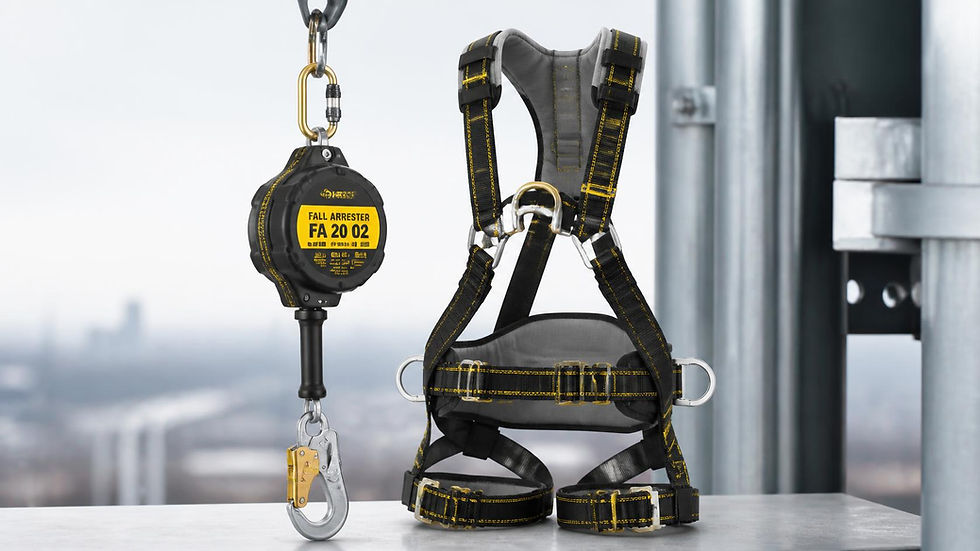
Working at height is one of the most hazardous activities across construction, maintenance, industrial, and facility-management projects. A reliable fall arrester can significantly reduce the consequences of a fall, but choosing the right equipment requires more than simply comparing prices.
From product standards and load capacity to compatibility, working conditions, inspection requirements, and supplier reliability, several factors should be evaluated before making a purchase. This guide explains the key considerations for selecting fall arrest equipment and other lifting equipment for safer work-at-height operations in the UAE.
1. Understand the Type of Fall Arrest Equipment You Need
Fall arrest systems are not one-size-fits-all. The right solution depends on the working environment, height, movement requirements, and type of application.
Common equipment includes:
Self-retracting lifelines (SRLs)
Vertical and horizontal lifelines
Full-body harnesses
Shock-absorbing lanyards
Rope grabs and guided-type fall arresters
Anchorage connectors
Temporary and permanent lifeline systems
Before purchasing, assess where the equipment will be used and how much freedom of movement workers require. For example, an SRL may be suitable where workers need greater horizontal mobility, while a guided fall arrester can be appropriate for vertical climbing applications.
2. Check Applicable Safety Standards
Safety certification should be one of the first things you verify when purchasing a fall arrester.
Look for equipment manufactured and tested according to applicable international or regional safety standards. Depending on the product, relevant standards may include EN standards and other recognized fall-protection requirements.
Certification provides evidence that the equipment has undergone defined testing procedures. However, buyers should also verify that the certification applies to the exact product model rather than assuming that every product from a particular supplier has the same certification.
3. Consider Maximum User Weight and Load Capacity
Every fall arrest system has specified performance and load limitations. The equipment must be suitable for the worker's total supported weight, including clothing, tools, and other carried equipment where applicable.
For example, if a worker carries tools while working at height, the additional weight should be considered when checking the manufacturer's rated capacity.
Never select equipment based only on appearance or general strength. Always check the manufacturer's technical documentation for:
Maximum user weight
Minimum and maximum working height
Maximum arresting force
Lifeline length
Required clearance
Anchorage requirements
Proper capacity selection is especially important when lifting equipment and fall protection equipment are used in demanding industrial environments.
4. Verify Equipment Compatibility
A fall arrest system normally consists of several interconnected components. The harness, lanyard, fall arrester, lifeline, and anchorage point must work together as a complete system.
Using individually certified components does not automatically mean the complete setup is suitable.
Before purchasing, confirm:
Connector compatibility
Harness attachment points
Lifeline diameter and material
Anchorage compatibility
Connector locking mechanism
Manufacturer's approved configurations
This is particularly important when replacing only one component of an existing fall protection system.
5. Evaluate the Working Environment
UAE work environments can expose equipment to heat, dust, humidity, chemicals, and intensive outdoor use. These conditions can influence equipment selection and service life.
Consider whether the fall arrester will be used in the following:
Construction sites
Warehouses
Industrial facilities
Oil and gas environments
Maintenance operations
Towers and elevated structures
Confined or restricted areas
For harsh environments, pay attention to corrosion resistance, material durability, UV resistance, operating temperature ranges, and protection against contamination.
6. Check Required Fall Clearance
A common mistake is assuming that wearing a fall arrester automatically eliminates the risk of striking a lower surface.
Fall arrest systems require sufficient clearance below the worker. The calculation can involve the worker's height, lanyard or lifeline length, energy absorber deployment, equipment elongation, harness effects, and an appropriate safety margin.
Always follow the manufacturer's clearance calculation and installation instructions.
If there is insufficient clearance, a different fall protection solution may be necessary.
7. Consider Worker Mobility and Application
Think about how workers will actually move while performing their tasks.
A maintenance worker moving across an elevated platform may require different equipment from someone climbing a vertical ladder. Selecting equipment based solely on the product category can result in poor mobility or an unsuitable setup.
Consider:
Vertical versus horizontal movement
Frequency of climbing
Required working distance
Need for hands-free operation
Potential swing-fall hazards
Frequency of equipment use
The best fall arrest equipment should provide protection without unnecessarily restricting safe movement.
8. Look at Material and Construction Quality
Material quality directly affects durability and reliability.
Common components may include high-strength synthetic webbing, galvanized or stainless-steel components, aluminum housings, energy absorbers, and corrosion-resistant connectors.
Examine the stitching, buckles, hooks, connectors, locking mechanisms, and housing construction. The equipment should feel robust and be appropriate for the intended application.
However, visual quality alone should never replace certification and technical verification.
9. Prioritize Inspection and Maintenance Requirements
Fall arrest equipment requires regular inspection and proper maintenance. Before purchasing, understand how the product should be inspected, cleaned, stored, and serviced.
Check whether the manufacturer provides:
Inspection guidelines
Maintenance instructions
Product identification and serial numbers
Replacement-part information
Service recommendations
Defined inspection intervals
Equipment involved in a fall should be removed from service and evaluated according to the manufacturer's instructions before being returned to use.
10. Choose a Reliable Supplier
The supplier is just as important as the product.
When sourcing fall arrest equipment in the UAE, choose a supplier that can provide genuine products, technical documentation, product certifications, application guidance, and after-sales support.
A reliable supplier should be able to help you understand which equipment is appropriate for your specific working conditions rather than simply recommending the cheapest option.
This is also important when sourcing other lifting equipment, where incorrect selection can create serious operational and safety risks.
11. Don't Make Price the Only Deciding Factor
Cost is naturally important, but fall protection equipment is safety-critical equipment. Choosing solely based on the lowest purchase price can result in compromises in quality, certification, durability, or technical support.
Instead, consider the total value of the equipment, including:
Product quality
Compliance and certification
Expected service life
Maintenance requirements
Supplier support
Availability of replacement components
Suitability for the application
A properly selected system can provide better long-term value while supporting safer working practices.
12. Train Workers Before Use
Even the best fall arrester cannot provide effective protection if workers do not know how to use it correctly.
Workers should understand how to:
Inspect equipment before use
Put on and adjust a harness correctly
Connect fall arrest components
Identify damaged equipment
Avoid unsafe anchorage points
Understand fall clearance
Recognize swing-fall hazards
Respond after a fall
Training should be specific to the equipment and work environment.
Why Professional Selection Matters
Fall arrest systems are part of a broader work-at-height safety strategy. Equipment selection should be based on a proper assessment of the task, hazards, work environment, worker requirements, and applicable safety procedures.
When purchasing fall arrester systems or lifting equipment, businesses should therefore consider compliance, compatibility, capacity, durability, application, inspection, and supplier support rather than focusing only on price.
Conclusion
Buying the right fall arrest equipment is an important investment in workplace safety. Before making a decision, evaluate the equipment type, certification, load capacity, compatibility, working environment, fall clearance, material quality, maintenance requirements, and supplier expertise.
For businesses looking for dependable fall arresters and lifting equipment in the UAE, Apex Lifting can be considered for sourcing suitable lifting and height-safety solutions. Select equipment according to the manufacturer's specifications and your site's specific requirements to support safer and more efficient operations.
FAQs
1. What is a fall arrester used for?
A fall arrester is designed to help protect a worker during a fall from height by limiting the fall and reducing the forces transmitted to the user when used as part of a suitable fall arrest system.
2. How do I choose the right fall arrester?
Consider the application, working height, required mobility, user weight, anchorage arrangement, fall clearance, environmental conditions, and applicable safety standards. Always follow the manufacturer's specifications.
3. Can fall arrest equipment be used with any harness?
Not necessarily. Fall arrest components should be compatible and used in configurations approved or specified by the manufacturer. Check the harness attachment points and connector requirements before use.
4. How often should fall arrest equipment be inspected?
Equipment should generally be inspected before each use and undergo periodic detailed inspection according to the manufacturer's instructions and applicable workplace procedures. Any equipment showing damage or involved in a fall should be removed from service and evaluated before reuse.


Comments